WELCOME

Welcome to our Gardening Club Rhydlewis and District Gardening Club has been around since the time of Adam and Eve. In fact, it is believed that one of our members planted and tended the very apple tree that gave rise to the pair being expelled from the garden!!

Whether this urban myth is true or not, the club is here to encourage, improve and extend the members' knowledge of all branches of horticulture. It is open to everyone and new members are all always welcome to come along.

Our activities during the year include a varied programme of talks and social events, summer garden visits, a plant sale, social gatherings/bbq and an annual open show in August.


Monday, 4 July 2016

The Autumn Produce Show 2016


RHYDLEWIS & DISTRICT GARDENING CLUB

AUTUMN PRODUCE SHOW

  ALL YOU NEED TO KNOW TO ENTER YOUR GARDEN'S HARVEST


The Produce Show is on TUESDAY 30th AUGUST 2016

at the

RHYDLEWIS VILLAGE HALL


STAGING FROM 3.00pm UNTIL 5.00pm: Judging from 5.00pm: 
SHOW OPENS AT 7.30pm 
with RAFFLE, REFRESHMENTS and AUCTION OF DONATED EXHIBITS

OPEN TO ALL EXHIBITORS – Entry Fees – per category:
Members of Gardening Club – Free
Non- Members of Rhydlewis Gardening Club – 10p per entry
JUDGES
Mike Sinnott – Vegetables, Fruit and Flowers
Sue Wright - Homecraft
AWARDS
  • Vegetable Challenge Cup - Awarded for the most points gained in the Vegetable and Fruit classes (1 - 26)
  • Floral Challenge Cup - Awarded for the most points gained in the Flowers and Floral Art classes (27 – 37)
  • D & G Williams Shield – Awarded for the most points gained in the Homecraft classes (38 – 54)
  • Roses Shield – Overall winner of Class 30
  • J.T. Davies Memorial Shield – Best exhibit in Class 10

SCHEDULE CATAGORIES ARE AS FOLLOWS:

VEGETABLES AND FRUITS
  1. 4 White Potatoes
  2. 4 Coloured Potatoes
  3. 3 Carrots – (any one variety)
  4. 3 Beetroot – (any one variety)
  5. 3 Courgettes – (any one variety) each not exceeding 15.2cm (6ins)
  6. 1 Marrow
  7. 4 Dwarf Beans
  8. 4 Runner Beans
  9. 4 Pods of Peas
  10. 3 Cooking Onions 
  11. 5 Shallots
  12. 4 Tomatoes
  13. 5 Cherry Tomatoes
  14. 1 Cucumber
  15. Collection of Vegetables – 5 varieties (tomatoes can be included)
  16. Oddly Shaped Vegetables
  17. Longest Runner Bean
  18. Collection of Culinary Herbs: Names to be listed
  19. Parsley – 4 cut stems in a vase
  20. 3 Cooking Apples (any one variety)
  21. 3 Eating Apples - (any one variety)
  22. 3 Pears - (any one variety)
  23. 3 Plums - (any one variety)
  24. Gooseberries – 1 dish not less than 10
  25. Collection of Fruit – 5 varieties
  26. 3 Rhubarb sticks – to include approx. 7.5 cm (3ins) of leaf
FLOWERS

  1. Vase of Dahlias – 3 heads of any one variety
  2. Vase of Hydrangeas – 3 heads of any one variety
  3. Vase of African Marigolds – 3 heads of any one variety
  4. Vase of Roses – 3 stems of any one variety
  5. Vase of Sweet Peas – 5 stems of any one variety
  6. Vase of Cut Flowers – not more than 6 varieties
  7. A Pot Plant in bloom
  8. A Pot Plant grown for its foliage
  9. Tree or Shrub – 1 cut stem for autumn flower, fruit or foliage effect
FLORAL ART
  1. A basket flower arrangement for the Queen’s 90th Birthday – not to exceed 24ins (60cm) overall
  2. A seasonal arrangement incorporating a tea cup and saucer. Size optional.  (Can include fruit and vegetables)
HOMECRAFT

  1. 1 Welsh Pastie – Short Crust Pastry 
  2. 1 Quiche – Maximum 12 inches
  3. 1 Bara Brith
  4. 5 Chocolate Chip Cookies
  5. 3 Brown Hens’ Eggs
  6. 3 White Hens’ Eggs
  7. Jar of Jam – Stone fruit
  8. Jar of Jam – Soft fruit
  9. Jar of Marmalade
  10. Jar of Honey
  11. Jar of Chutney
  12. Jar of Pickles
  13. 1 Bottle of Homemade Cordial
  14. 1 Bottle of Country Wine
  15. A Hand Knitted item
  16. An Article of Patchwork
  17. Any Handmade art or craft on the theme of ‘Hedgerows’ (Any medium)
RULES
  • Entries in the flower, fruit and vegetable classes, unless otherwise stated should consist of one variety
  • All arrangements to consist of fresh or dried plant material unless otherwise stated
  • Stalks should be left on tomatoes, and where applicable, on fruit
  • All exhibits must have been grown by the exhibitor (not applicable to the floral art section)
  • For the purposes of the show, “vase” means any suitable container for displaying cut flowers and “pot” means any suitable containing in which a plant can grow
  • Help will be given with staging and classification if needed
  • Rhydlewis Gardening Club cannot be responsible for anything left in the hall after the Show. If necessary, label vases and containers.
  • ANY OBJECTION TO AN EXHIBIT MUST BE MADE TO THE SHOW SECRETARY ON THE NIGHT OF THE SHOW
  • In the event of a dispute, the committee reserves the right to inspect gardens and, if necessary to disqualify.

ADVICE AND RHS GUIDELINES TO HELP YOU ENTER THE VERY BEST OF YOUR  HARVEST…
VEGETABLES
Potatoes - Always wash the potatoes carefully trying not to break the skin. Choose even sized tubers of similar shape. Discard any tubers with slug damage. Try to use potatoes that have no scab marks. 
Carrots - Wash the roots carefully with a soft cloth and plenty of water, trying not to damage the skins. Check the roots for any slug or worm damage and discard. Choose roots, which are roughly the same size and shape. Cut off the leaves to about 3-4 cm (1"/1½”) above the top of the root, and tie together with either raffia or garden string.
Beetroot - Wash the roots carefully with a soft cloth and plenty of water, trying not to damage the skins. Choose roots, which are roughly the same size and shape. Retain full length of tap root.
Courgettes - These need to be even sized ideally with their flowers still attached. Cut the courgettes with a knife leaving a small piece of stem. Check schedule for size requirement.
Marrows - Need to be cut leaving a small piece of stem. Stage directly on the show bench after wiping clean.
Beans - Whatever type of bean you are showing, (dwarfs or runners), make sure they are young as the Judge will snap them just to see if they are stringy. They need to be the same length and shape, and have a little bit of stalk left on them. Make sure the beans have no brown marks or slug holes. 
Peas - Peas should have nice full pods, and should all be the same length. Always cut the stems a little away from the pod and handle the peas by the stem. Ideally pea pods should retain the "bloom".
Onions –Onions need to dry off, so they need to be lifted fairly early and put somewhere for the skins to dry. Rub off the loose skins when the bulbs are dry. Cut the stems leaving enough to be able to turn over and tie with either raffia or garden string. Don't tie the onions too early as the stems shrink if left to dry out. Very carefully slice the roots off close to the bottom of the bulb. Choose even sized bulbs that are of the same shape and size.
Shallots – These are treated the same as onions. Make sure the shallot has only one bulb, as sometimes there is a little bulb hiding under the skin. To exhibit shallots, they should be put on a container of dry sand.
Tomatoes – Select ripe but firm, richly coloured fruit of even size. Cut the tomato stem leaving a little stalk and the green bit on. Wash the fruit well to remove any water marks before staging your fruit. Stage on a plate with stalks uppermost. The same applies to cherry tomatoes.
Cucumbers - Select fresh, young, straight fruits of uniform thickness, with short stems and flowers still attached - retain waxy bloom.
FRUIT
General - Pick fruit as near to show time as practicable - retain stalks. Do not polish fruits - leave the natural bloom. Do not select over-ripe fruits.
Apples - Select large, solid unblemished fruits of shape and colour typical of the cultivar with stalks intact.
Pears – Select large, solid unblemished fruits of shape and colour typical of the cultivar with stalks intact.
Plums - Select large ripe, but firm fruits of good colour, with stalks intact. 
Gooseberries - Select large ripe fruits of good colour with stalks. Stalks should look green and fresh and all point one way when staged.
Rhubarb – Rhubarb is always pulled not cut. Trim the leaves to the requirement in the schedule.
FLOWERS
General - Select flowers in good fresh condition and free from damage due to weather, pests or disease. There should be no marks on the petals or leaves. Select flowers with straight stems, and the same size. Flowers should be displayed in a vase having a greater height than the width measurement of its mouth.
FLORAL ART - Check schedule for class requirements. 
HOMECRAFT
Baking General – Check schedule for class requirements. All items will be cut and tasted. Marks are also given for presentation as well as uniformity, taste and flavour. 
Welsh Pastie – known is an Oggie – is made with Welsh lamb and leeks. See also notes under baking general.
Quiche – A generous amount of filling and the pastry evenly cooked throughout. Please state what type of quiche you have baked. See also notes under baking general.
Bara Brith - This ‘speckled bread’ is a fruit loaf made with tea. Some recipes contain yeast and others not – both will be acceptable for this competition.
Chocolate Chip Cookies –See also notes under baking general.
Eggs - Eggs should be of uniform colour and size.
Preserves General – The flavour, consistency and colour are all judged together with the overall presentation. Jars must be filled to the top (this prevents mould forming). Jars can either be sealed with a twist off lid OR have a waxed disc (smooth side down), and a cellophane top. After filling and cooling the jars should be cleaned and polished with a clean cloth to remove fingerprints and any spillage. All jars should be labelled, and state the contents plus the day, month and year of making.
Jams – Jams are a mixture of fruit and sugar. They should be clear and bright, characteristic in colour and well set but not too stiff. See notes under preserves general for tips on pots and labelling.
Marmalades – Marmalades are a jam like preserve based on citrus fruits. It also generally includes the peel. See notes under preserves general for tips on pots and labelling.
Honey - Clean jar and screw top lid. The honey should be clear and free of impurities. 
Chutney – Chutneys are based on almost any combination of fruit and vegetables but always contain acid (usually vinegar), spices and sugar. Jars of chutneys should be allowed to mature for a few weeks before use to produce a mellow but flavour full of character. See notes under preserves general for tips on pots and labelling.
Pickles – Salt or brine is used to extract water from large pieces or whole vegetables. They are then packed in a vinegar which can be plain, spiced or sweet. See notes under preserves general for tips on pots and labelling.
Homemade Cordial – A cordial is a sweet flavoured fruit drink which is diluted with water for drinking. It should be in a clear glass bottle with a screw top lid and an airtight seal.  The colour should be bright and the bottle filled to within 2.5 cm from the top.  The consistency should not be thick or clotted but a genuine pouring consistency.  The flavour should stand a dilution of 1 part cordial to 5 parts of water for drinking.
Country Wine - A Country wine is a beverage produced by fermenting the juices of fruits, vegetables or flowers. It will be judged on flavour, body, clearness and colour.
Handicrafts – These must be the exhibitor’s own work and have a tidy finish and be fit for purpose.  Recycled materials may be used where appropriate.


AND…. Most importantly, have a go and have fun entering.  Chat to other gardening club members for advice and tips on selecting and showing your produce.  The more categories you enter, the better your chance of a win, and the more successful our club’s show will be for everyone!!

For further information please contact the club secretaries 
Nina and Jim 01239 851096; or show secretary Liz 01239 851851

Monday, 11 April 2016

SPRING SHOW TUESDAY 29th MARCH 2016

The CLWB GARDDIO RHYDLEWIS A’R CYLCH RHYDLEWIS AND DISTRICT GARDENING CLUB SPRING SHOW TUESDAY 29th MARCH 2016

Best friends Jean and Marj are both winners - OVERALL WINNER – Most Points in classes 1-21 and THE DERRICK AND BARBARA CALOW MEMORIAL CUP – Best Exhibit in classes 1-15

Our JUDGES were Roger and Eirian Spencer – Trefhedyn Garden Centre. 

THE PRIZE-GIVING WAS FOLLOWED BY RAFFLE AND REFRESHMENTS 
AND AUCTION OF DONATED EXHIBITS 


FLOWERS

  1. Primula (including primrose, polyanthus, cowslip etc) 

We always have a large number of entries of Narcissus (which includes all daffodils) at this show. In order to provide clearly defined classes, we try to use the Royal Horticultural Society classification into divisions. 
tulip and narcissus classes 

  1. Vase of cut heathers (Erica or Calluna
  2. one or more varieties
Dish of Hellebore Heads


An ‘Easter Basket’ 
floral arrangement 


  1.  FLORAL ART 
    A floral arrangement entitled,
     ‘Changing Seasons’.  Size optional.

     ART, CRAFT AND PHOTOGRAPHY CLASSES


A photograph; 'any old iron'


Friday, 5 February 2016

Preserving From Your Garden

Thank you, Vicky Wade, for a very comprehensive talk and demonstration on preserving all the fruit and vegetables (and eggs!) we harvest from our garden. 

Vicky covered making jams, jellies, chutneys, pickles, and many other preserves. As this was our January talk, and Seville oranges are in the shops, she showed us, step by step, how to make marmalade. 

Vicky fascinated us all with stories of her own childhood, helping her mother in a 50's kitchen with produce from their allotment. She had many handy tips, including this one…


(Taken from the Sainsbury book of Preserves and Pickles by Heather Lambert.)


Test for Pectin
Put 1 teaspoon juice from the pan (of cooked fruit) into a small glass. Leave until cold, then add 3 teaspoons methylated spirit. Shake gently and leave for 1 minute.
A jelly like lump indicates plenty of pectin present and up to 750 g (1.5 lb) sugar can be added for each 500 g (1 lb) fruit pulp and juice;
 2 or 3 less firm clots shows moderate pectin and 500 g (1lb) sugar can be added for each 500 g (1 lb) fruit pulp and juice.
The more sugar you add the greater the yield will be without affecting the sweetness of the jam.

I have found this pectin test particularly useful when I haven't been following a recipe precisely or have an odd quantity of fruit for which I need to check how much sugar is required.

And don't forget that there are great  preserving recipes to follow in Judith Russill's book:
"Judith's Dark Secrets - in the kitchen" 
now only £2, and available from Rhydlewis House, (01 239  851748) or from the Bridge Stores.


Tuesday, 1 December 2015

At One with Nature – Sue Parker and Pat O'Reilly of First Nature, consider the role of gardening in nature conservation


At One with Nature
Sue Parker and Pat O’Reilly, 
First Nature,  
Fig1s –
The Snapdragon, Antirrhinum majus
– tailor made for bees. 
consider the role of gardening in nature conservation
The role of gardening and gardeners in plant conservation is well known: botanical gardens around the world play a vital part in protecting endangered plants from extinction. This is a far cry from their beginnings, when they were developed mainly to house and propagate plants such as tea, tobacco and palms for their cash-crop value. Today, these gardens focus more on research and education, and as attractions that delight and inspire millions of visitors every year.
Fig2s –
A wildlife garden managed for insects –
 early springtime
Our own much smaller-scale gardening efforts may not attract massive grants from important organisations charged with attempting to reverse the mass extinction of plants and animals, but we can still play an important role in the conservation of wildlife. If you were to add up the total amount of land occupied by gardens across Wales, it would easily dwarf even the collective size of our botanical gardens and probably bear comparison with some of our national parks and nature reserves. 
How can we capitalise on this resource for the benefit of birds, insects and other wild animals? So-called 'wild' gardens may appeal to those who see this as an ecologically sound justification for avoiding the hard work needed to create a more formal backdrop to our homes. Others may simply see as a complete anathema gardens left in the busy hands of Mother Nature as overrun with 'weeds' whose hobbies include ripping clothing and flesh.  In reality, small changes to what we grow (and where) can determine whether or not our gardens are wildlife friendly.
Fig3s –
A wildlife garden managed for insects –
high summer
.
Gardens that reflect the surrounding vegetation have another advantage. They provide corridors through which wildlife can more easily migrate if their homes in the wild are damaged or destroyed either by natural disaster or by industrial zones, houses and other developments built with little or no regard for the ecological heritage of the area.
Growing native plants that have long-established relationships with Wales’s landscape and the creatures that live here is one of the surest routes to success, both for the gardener and for the local wildlife. This is true whether we grow plants for their beauty or their food value. Looking at the garden as a whole (thinking of it in ecosystem terms) rather than as a series of separate beds, borders and lawn areas can help, too. Putting plants in positions where they would thrive in the wild means that not only are they more likely to do well but also that they may quickly form mutually beneficial relationships with insects and other creatures that favour the same habitats. Such a garden becomes part of the complex web of biological relationships that occur in nature. 
Fig4s –
The Peacock Butterfly,  Inachis io –
 a lovely free late summer garden ornament
 if you get the plants right.
Large expanses of chemically-managed lawns devoid of trees, plants and other features benefit very few wildlife species; and, with drought becoming an increasing problem, they are costly in terms of water resources. 
One of the most pressing conservation problems is the alarming decrease in pollinating insects. Whatever is damaging them (and the jury is still out) is sure to be harming other insects, among them our native colourful butterflies and moths. Some flowers are much more beneficial to these kinds of insects than others are, and so it is worth trying to find out which plants are the best. Fortunately there are clues all around us, and even a short walk in spring or early summer will take you past a range of plants, some of which will be buzzing with insects. 
Bees, which can see ultraviolet, are attracted to plants with purple or blue flowers. The trick is to choose those that are sturdy enough to support the bee’s weight and shaped to suit its girth. A snapdragon, for instance, has a ready-made platform that leads the bee down a funnel to where it finds nectar - its reward for helping with pollination. Most butterflies like pink and yellow flowers, but they dislike windy and shady places. Plants chosen to support butterflies should therefore be grown in sheltered sunny spots, and preferably in big clumps rather than individual specimens. Planning for a succession of flowers that insects like will ensure that they have food throughout the year. 

Fig5s – 
The Orange-tip Butterfly, Anthocharis cardamines –
 most visible in springtime
 when the Cuckoo Flowers Cardamine pratensis are blooming.

Of course, if you can talk your neighbours into growing wildlife-friendly plants too, the wildlife will have an even bigger area in which to hunt for food without being exposed to predators as they travel from one small food bank to another.


Wednesday, 25 November 2015

Alex Hales - Christmas decorations from your garden

We were most fortunate to have Alex Hales. from No 21, the florists in Aberystwyth, who came to demonstrate how to use greenery and late flowers to create fabulous, traditional christmas deorations from your gaden. 
We learnt how to make a simple table decoration just using a flowerpot and a few bits of greenery from the garden, and a very impressive table decoration which included roses. Watching Alex make his Christmas wreath was a treat; again all you need is some florists wire (moss wire), clippings of greenery, berries and a nice, red bow, plus whichever fir cones and other natural decorations you choose. It looked a lot easier than I imagine it really was! 


The tiny milk bottles Alex uses in this larger decoration can be purchased from his shop as can dried apple decorations, orange slices and whole dried oranges, cinnamon sticks etc.                              

Thank you Alex, I'm sure a lot of us will be inspired this year, and those who felt it was all a bit above their skill level can see what Alex has to offer at http.www.no21flowers.co.uk

Wednesday, 26 August 2015

Rhydlewis Gardening Club Anual Produce Show


At three pm on the afternoon of Tuesday the 25th August, Rhylewis Village Hall looked like this; ready and willing to be transformed. 

Then contributors began to arrive, and the exhibits just kept coming!  


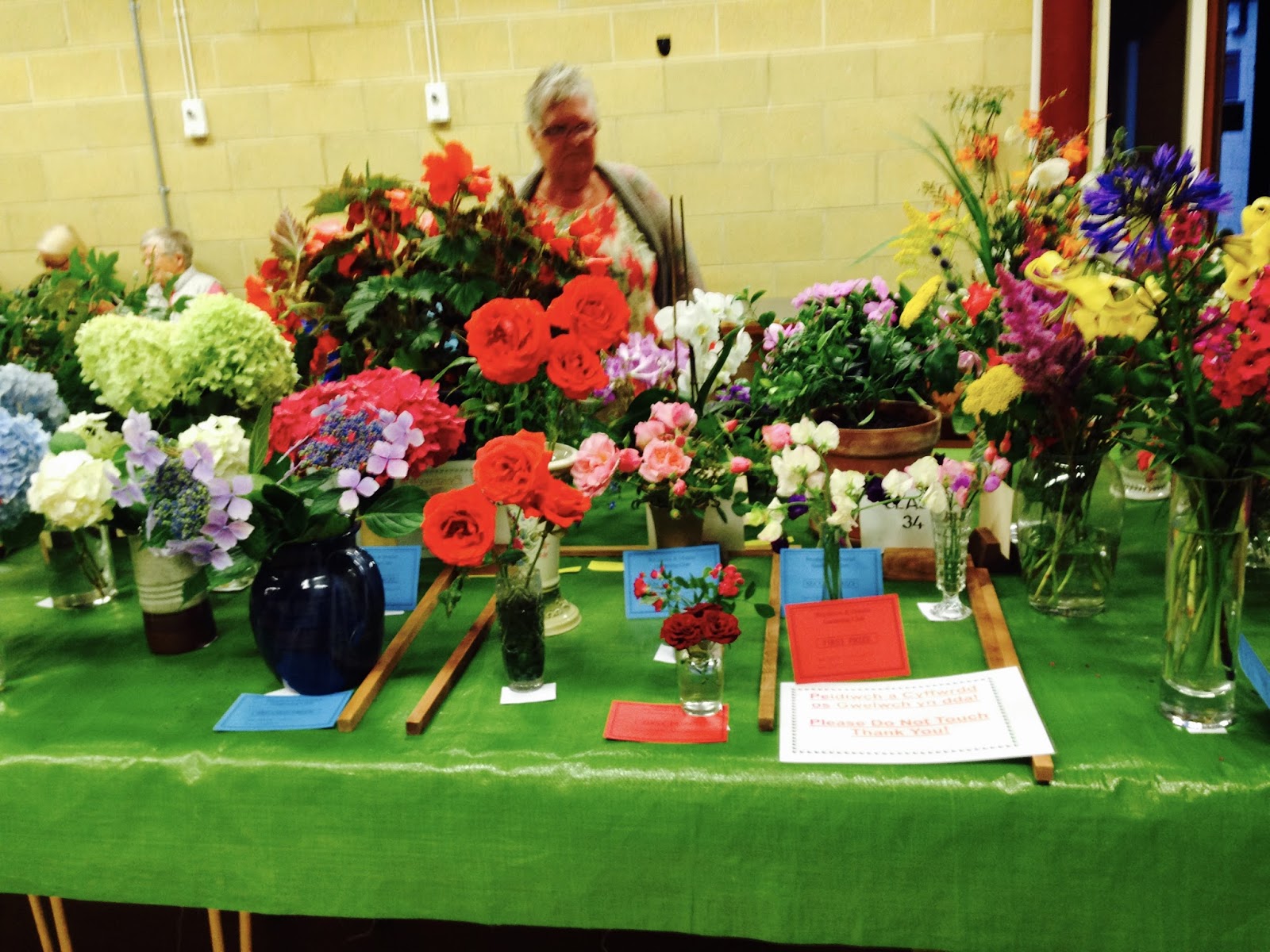
LIlies in Class 35, a vase of cut garden flowers


Floral Class 31
Three Hydrageas Heads

Fantastic display of Pot Plants in Bloom in Class 36
By five pm, when the judges were due to arrive, it was bursting with vegetables, fruit, flowers and homecraft goodies.

Floral Art, Class 39, A Basket of Flowers for the New Royal Baby
and Class 40, a seasonal arragement incorporating a tea cup and saucer.

A delicious-looking baking section, Classes 41, 42, 43, 44, 45
Homecraft Classes 47,48, 49,
Jams and Marmalades 


The Homecraft sections did well this year, as so did both the floral garden sections and the floral art sections, thanks to members contributions and the contributions of the new Rhydlewis Art Group. Vegetables were understandably thin on the ground (and below it); the onion sections particularly did poorly because of constant wet soil. 
Class 5, a popular one this year; Courgettes!
But a fantastic turnout, and a very enjoyable evening, which included the auction of generously donated exhibits. Miar Morgan, longstanding member, stated that it was the best Produce Show she could remember.
Congratulations to all who entered – all the exhibits made the show what it was, not just the prize-winners. However, very, very well done to the prize-winners too! The winners of the categories are as follows:
Floral Prize (most points gained in the floral classes) Jenny Archibald, Newcastle Emlyn.

Challenge Cup (most points gained in vegetable and fruit classes) Janette Sharman, Rhydlewis.

Roses Shield for class 33   Marg Fogg, Tregroes.

D & G Williams Shield (most points gained in homecraft section) Vicky Wade, Brongest.

Huge thanks to the new Show Secretary, Liz Blackler, for organizing the show, to the judges and all the volunteers.